Independent project / Case study
AI Skill: PM Interviewer
AI-guided product interview practice.
Independent project · Framework adaptation, interaction design & iteration
- AI learning workflow
- Interaction design
- Qualitative evaluation
At a glance
AI skill for practising PM interviews with structured prompts, examples, and coaching.
AI instruction workflow. Framework: Ben Erez / Lenny’s Newsletter.
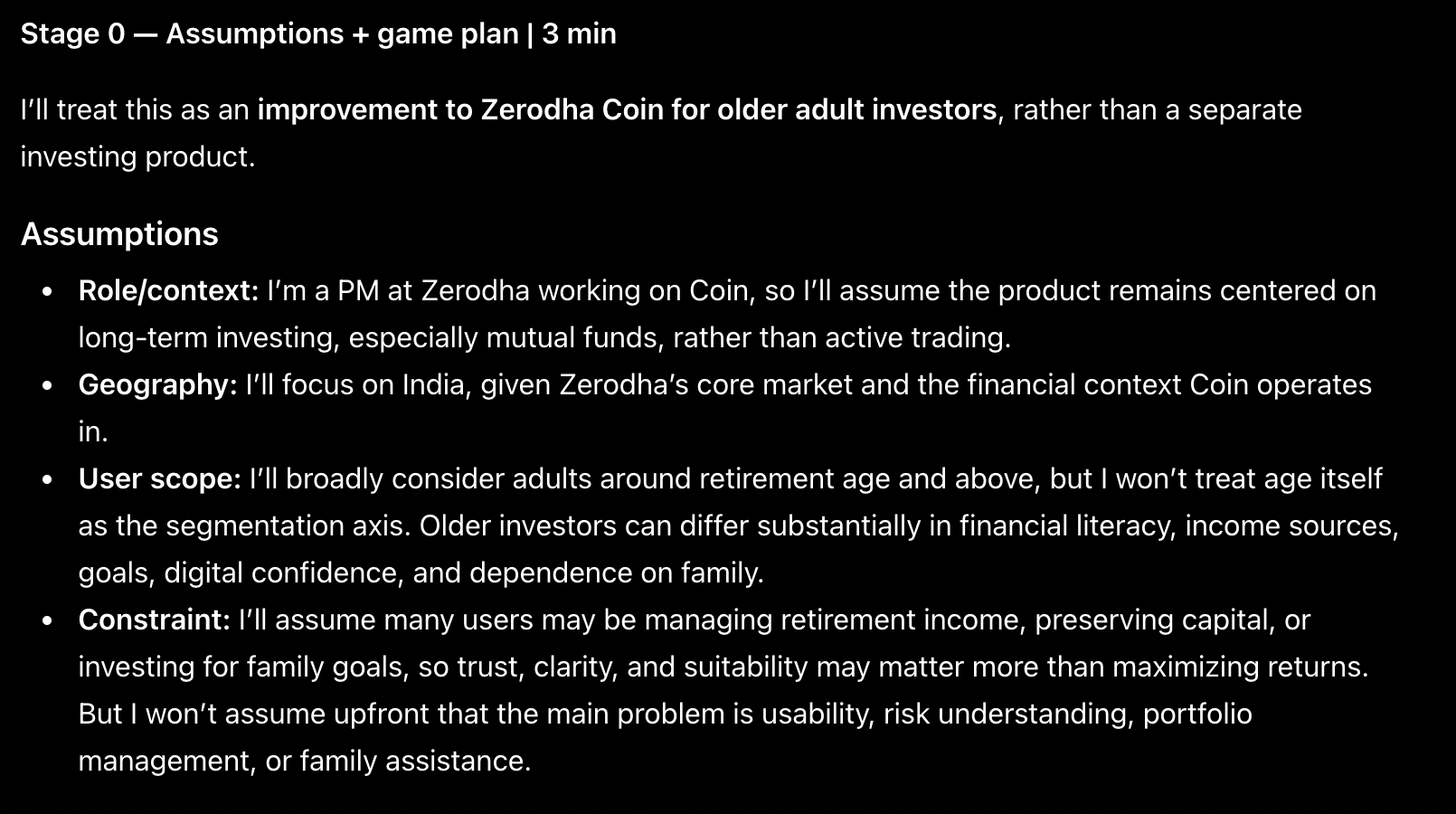
User scope excerpt
I’ll broadly consider adults around retirement age and above, but I won’t treat age itself as the segmentation axis. Older investors can differ substantially in financial literacy, income sources, goals, digital confidence, and dependence on family.
User scope · Hypothetical Zerodha Coin exercise · Excerpt
Owner-provided response. Framework foundation: Ben Erez / Lenny’s Newsletter.
No Zerodha affiliation or hosted chatbot.
AI Skill: PM Interviewer · Assumptions example
The problem: an answer is not a learning experience
A polished Product Sense answer can show the destination without making the reasoning reusable. I adapted a framework into staged practice: choosing a user, prioritizing a problem, comparing solutions, and explaining the decisions that connect them.
What I built
I adapted the credited framework into reusable instructions, designed the interaction, refined the rules, and documented setup and limitations. It runs as an instruction-based experience inside ChatGPT, not as a separately hosted application or a trained model.
In Candidate mode, the AI demonstrates an answer one stage at a time. In Instructor mode, the person answers while the AI interviews and coaches. Stage checkpoints and pacing estimates keep the flow bounded. Visible decisions, separate coaching cues, and reusable patterns expose the method alongside the answer.
The decision: teach the method, not just the answer
A reasoning-focused revision produced polished answers but made the method harder to learn. I separated natural Candidate speech from compact coaching marked “not spoken,” and treated answer quality and learning quality as different goals.
Segmentation also required reversals. A single dominant axis made categories consistent but sometimes hid combinations that changed the need. A later peer-archetype rule could still become too rigid. The current instructions favor recognizable, need-based groups whose differences could change the product decision, without allowing arbitrary combinations.
An example of the teaching layer
The public Candidate example frames a product for people moving to a new city, then pauses after the first stage. Its separate coaching layer names the purpose of that stage. This is a newly written public-safe illustration, not a benchmark transcript or a live demo.
Example
Define the playing field without prematurely choosing the user, problem, or solution.
What the evaluation does - and does not - show
I used qualitative, model-assisted review of generated Candidate answers and synthetic Instructor cases to refine the instructions. Most retained runs were single samples, and development prompts were reused. There is no independent human learning study or retained full-suite rerun for the exact public release. These checks do not establish measured learning or hiring gains.
Foundation, attribution, and next learning
Ben Erez’s framework, published by Lenny’s Newsletter, provides the foundation. My work is the adaptation and iteration, with ChatGPT and Codex assistance for drafting, critique, instruction revision, testing support, and repository implementation. I do not claim to have invented the underlying methodology.
This is an independent project, not an official or endorsed Stripe or OpenAI product. No reuse license has been selected. Fresh prompts, repeated trials, and blinded human review would be useful next steps. Model behavior varies, and employer-specific calibration remains unestablished.